
Fill Arís - Return Again
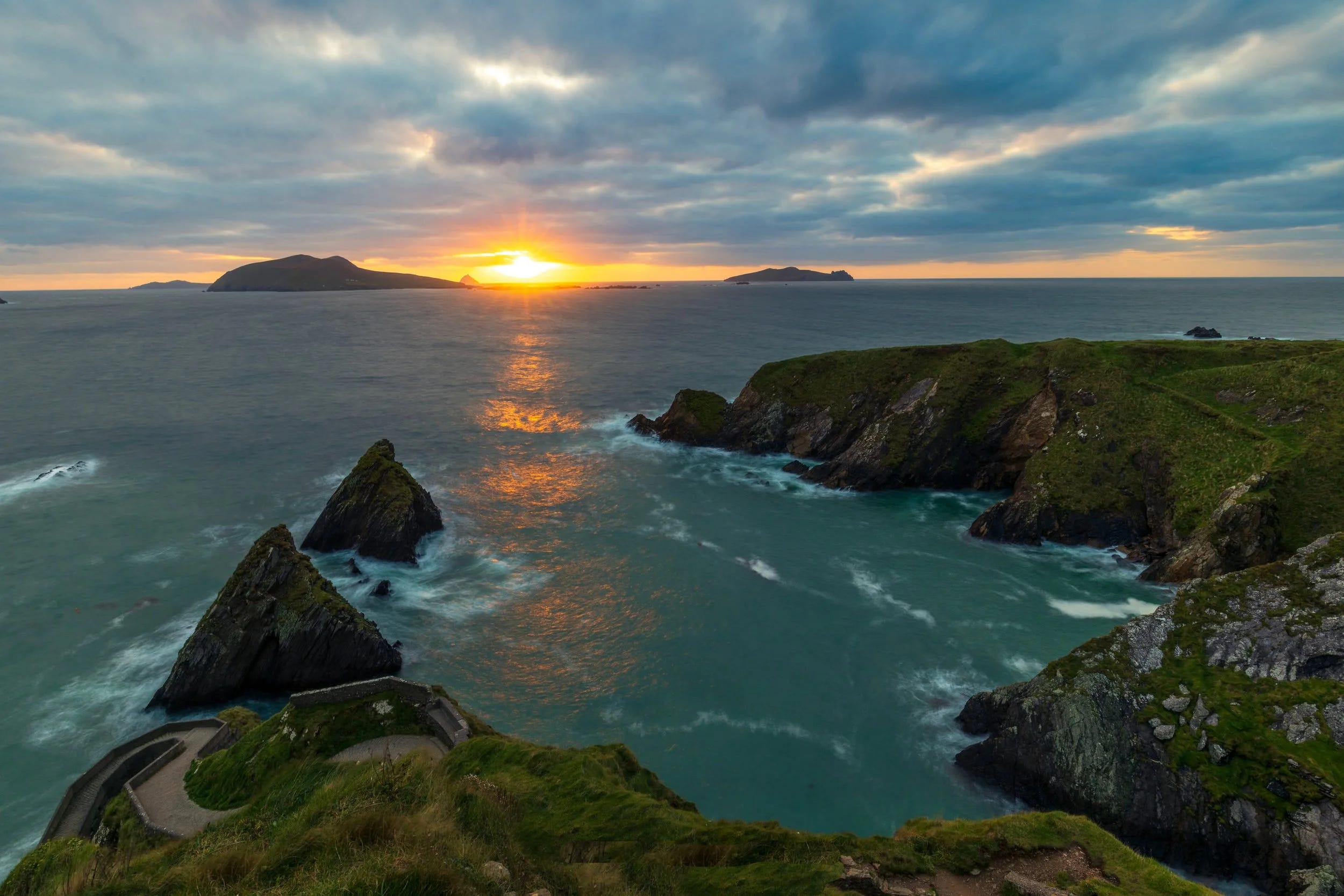
Dun Chaoin Fé Sholas an Tráthnóna

Beannachtaí na Féile Pádraig ort a chara!
Happy St. Patrick’s Day! I hope you have a great one, wear the green, and maybe even get to drown the Shamrock!
I thought I’d share with you one of my favourite poems to celebrate: Fill Arís by Seán Ó Ríordáin or An Ríordánach.
Ar dtús báire an dán féin ~ to start, here’s the full version as Gaeilge:
Fill Arís
Fág Gleann na nGealt thoir,
Is a bhfuil d’aois seo ár dTiarna i d’fhuil,
Dún d’intinn ar ar tharla
Ó buaileadh Cath Chionn tSáile,
Is ón uair go bhfuil an t-ualach trom
Is an bóthar fada, bain ded mheabhair
Srathar shibhialtacht an Bhéarla,
Shelley, Keats is Shakespeare:
Fill arís ar do chuid,
Nigh d’intinn is nigh
Do theanga a chuaigh ceangailte i gcomhréiribh
‘Bhí bunoscoinn le d’éirim:
Deis d’fhaoistin is dein
Síocháin led ghiniúin féinig
Is led thigh-se féin is ná tréig iad,
Ní dual do neach a thigh ná a threabh a thréigean.
Téir faobhar na faille siar tráthnóna gréine go Corca Dhuibhne,
Is chífir thiar ag bun na spéire ag ráthaíocht ann
An Uimhir Dhé, is an Modh Foshuiteach,
Is an tuiseal gairmeach ar bhéalaibh daoine:
Sin é do doras
Dún Chaoin fé sholas an tráthnóna,
Buail is osclófar,
D’intinn féin is do chló ceart.
And here’s An Ríordánach himself reading the poem.
The poem is a great celebration of the language and an invocation to the Irish person to return to it.
Here’s my take on what the words mean, in case that’s useful for you:
Fill Arís
Return Again
Fág Gleann na nGealt thoir,
This first line is one of the most meaning-filled you’ll find anywhere. It literally means: leave the glen of the lunatics east.
Gleann na nGealt is an actual place; it is a townland near Camp in Co. Kerry on the northern side of the Dingle peninsula. It is on the N86 and you pass it as you go over An Chonair ~ the Conor Pass to Dingle from Tralee; so you literally must leave Gleann na nGealt east to get to Corca Dhuibhne in the west.
And, of course, he is telling us to leave the madness of the east that is the Anglosphere and everything to do with it. The place is called Gleann na nGealt as there is a well there called Tobar na nGealt, the Well of the Mad. This well is associated with the legend of Suibhne Gealt ~ Mad Sweeney, who is supposed to have found peace there, something he could not find anywhere else. Interestingly, in 2012 water analysis on the well found higher than usual levels of lithium in the water of the well.
Is a bhfuil d’aois seo ár dTiarna i d’fhuil,
Literally: and whatever of this age of our Lord is in your blood
Dún d’intinn ar ar tharla
Ó buaileadh Cath Chionn tSáile,
Close your mind to what happened since the defeat at the Battle of Kinsale
The Battle of Kinsale happened in 1601 in, well, Kinsale, Co. Cork. It marked the end of what is known as the Nine Years’ War, an uprising by the Gaelic aristocracy lead by Hugh O’Neill against Elizabethan Rule in Ireland. The war had been a close-run thing, with many significant losses by the English to the Irish, and Ireland was a bit of a nightmare for Elizabethan England, kind of Elizabeth’s Vietnam (if Elizabeth I were Richard Nixon).
The English had famously fought off the Spanish Armada in 1588, and now the Spanish were back to support the rebellious Irish. But it was a disaster from an Irish point of view. Strategically the choice of landing place couldn’t have been worse. O’Neill’s strength was in the North and having to come all the way to the South coast to meet the Spanish at Kinsale meant a long forced march over the entire, then heavily wooded, country in mid-winter.
The battle, and consequently the war, was eventually decisively lost by the Irish and it lead to the departure of the head of the entire Gaelic noble class in 1607, with what is known as the Flight of the Earls. The plantations of Munster and Ulster followed, and the Anglicisation of Ireland ensued. The Battle of Kinsale is a pivotal event in what followed.
Is ón uair go bhfuil an t-ualach trom
Is an bóthar fada, bain ded mheabhair
Srathar shibhialtacht an Bhéarla,
Shelley, Keats is Shakespeare:
And since the load is heavy
And the road is long, cast from your mind
The civilising yoke of English
Shelly, Keats and Shakespeare
Here we have a call for the rejection of, or driving out of, this civilising yoke of English that the Irish have been subjected to since Kinsale. And while it sounds great as a call to arms, I really wonder if he means it, or can mean it.
English provided Ó Ríordáin with access to Blake, Yeats, Beckett, Hopkins, Ibsen, Strindberg and many other writers who influenced his writing. But if we are to go in for the cultural re-education that is being suggested here, or the decolonisation of the mind, to put it how it is currently popularly expressed, where would that leave us as Irish people with both an Irish and an Anglo-Irish cultural tradition? It seems to me to be particularly the case this week: if we were to cast off this yoke of English entirely as An Ríordánach is suggesting, where would that leave Maggie O’Farrell, or indeed Jessie Buckley?
Fill arís ar do chuid,
Nigh d’intinn is nigh
Do theanga a chuaigh ceangailte i gcomhréiribh
‘Bhí bunoscoinn le d’éirim:
Return again to your own
Cleanse your mind and cleanse
Your tongue that got mixed up in a syntax
That is utterly at odds with your intellect
Deis d’fhaoistin is dein
Síocháin led ghiniúin féinig
Is led thigh-se féin is ná tréig iad,
Ní dual do neach a thigh ná a threabh a thréigean.
Make your confession and make
Peace with your own lineage
And with your own house and don’t abandon them
It is not natural for a body to abandon its house or its tribe
Téir faobhar na faille siar tráthnóna gréine go Corca Dhuibhne,
Is chífir thiar ag bun na spéire ag ráthaíocht ann
An Uimhir Dhé, is an Modh Foshuiteach,
Is an tuiseal gairmeach ar bhéalaibh daoine:
Go west to the cliff edges in the evening sun in Corca Dhuibhne
And you will see there, rowing on the horizon
The Dual Number and the Subjunctive Mood
And the vocative case on the mouths of the people
Sin é do doras
Dún Chaoin fé sholas an tráthnóna,
Buail is osclófar,
D’intinn féin is do chló ceart.
That is your door
Dún Chaoin in the evening sun
Knock and your own mind
and your true form will be opened.
Here’s another version of the poem being read by Joe Ó Fátharta. Joe and Patricia Nic Eoin are the founders of Listen Up Irish who I spoke on Episode 1 of Season 2 of the Podcast which you can listen to here.
By a funny coincidence, I went to see Báite on Friday and I was delighted to see Joe appear in a cameo role as Fear Áitiúil 2! Jessie Buckley had better watch out!
Meanwhile, Patricia and Joe’s next reading challenge in Listen Up Irish is Ó Am go hAm and you can see details on that here.
Can I ask you consider one thing? Just as a puppy is not just for Christmas, Irish is not just for Patrick’s Day. Congratulations on your interest, keep it up! Coinnigh ort agus bí linn!
Sonas ort agus go mbaine tú súp as an lá mór! Have a great St. Patrick’s Day!