
Language Capture
When we place things on pedestals, we deny them their power

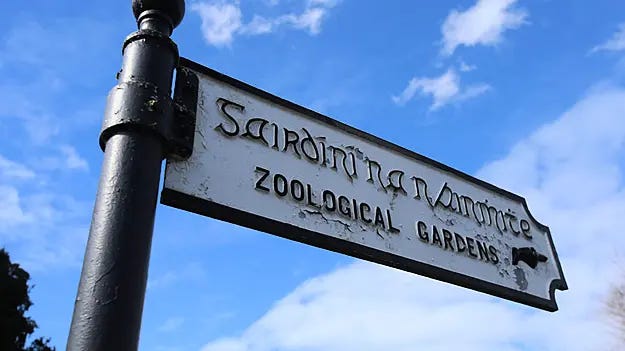
The Zoo! The Zoo! The Zoo!
It was the ultimate trip growing up: to Dublin, yes, but really, to the only thing you wanted to see was, the Zoo. I remember so many aspects of it so vividly from early childhood, I wonder now, how much of it is memory, or dream?
The reptile house, in particular, stays in my mind, as I recall a long, low building. At one narrow end, there was the crocodile. My memory of this creature in Dublin Zoo in the 1970s is especially vivid; so much so that I can no longer be sure whether I have imagined it.
It was, then, to me, a huge animal, lying prone, in what I can only describe from this image in my memory, or my mind, as a glorified bathtub, surrounded by coins of varying degrees of shininess.
If this seems surreal, it was, but I’ll swear it was true.
My abiding memory was the poor creature’s back and skin, a dinosaur in the flesh; I wanted to reach down and touch it, hopelessly curious to see what it felt like; what was it really like?
Of course, you couldn’t put your hands inside; this was a dangerous, wild animal: one that could devour you, whole. And it probably wasn’t very clean, and for thousands of other reasons, no, this was a curiosity you were not going to be able to satisfy: no matter how it eats at you; we can’t risk having him eat you, now can we?
You can look, but you cannot touch.
The books on my grandfather’s shelf held a similar tactile fascination for me. These, it was permissible to reach up and touch; cloth-covered hardbacks without dust jackets, faded blue, brown, or green covers with rune-like letters on the spines.
These you could lift down carefully, and feel, and heft the weight in your hands. You could crack open the covers and leaf through the pages, stick your nose into the crease at the back, near the spine and breathe in deeply to inhale that musty old book smell.
But the text written there remained a runic mystery.
You could touch, but you could not read.
The books were, of course, in Irish, as my maternal grandfather was a great speaker, reader, and general lover of the language, and this little library of his on this bookshelf was a place of great privilege to be allowed to explore.
I was a relatively precocious reader as a child and loved to devour books (whole), but these books remained forbiddingly inaccessible. Not only was the language strange and incomprehensible to me, but the script itself was indecipherable; I know now that these books were written in the cló Gaelach ~ Gaelic type, the traditional alphabet and writing of the Irish language and not the cló Rómhánach ~ Roman type into which writing in the Irish language had to evolve in the 1960’s as the technological advancement of the typewriter meant that officialdom needed to be able to write in the language using an alphabet that could be typed with the available equipment of the day.
And while I was a curious kid who loved to read, reading meant stuff that was accessible, new, interesting, relevant to me; what did this Irish stuff have to offer me other than the drudgery of having to learn it before I could even begin? And then why on earth would you want to bother to read the stuff that was in those old books anyway?
I have since gone back to learn the Irish language as an adult, and I did the Leaving Certificate in Irish again in 2020. There is a poem on the syllabus that will be familiar to anyone who has studied the language to Leaving Cert level in recent years, Géibheann le Caitlín Maude.
I had never connected the two before sitting down to write this, but when I thought of that crocodile from the Dublin Zoo of my youth, the first thing that came to my mind was that poem.
The poem is in the first person, recited by a wild animal from the tropics, famed and renowned for its natural beauty:
Ainmhí mé
…
a bhfuil clú agus cáil
ar mo scéimh
The trees of forests would once shake at its roar:
chroithfinn crainnte na coille
tráth
le mo gháir
But now it is reduced to lying depressed in some compound gazing out of the side of its eye, not at forests, but a solitary tree:
agus breathnaím trí leathshúil
ar an gcrann aonraic sin thall
Hundreds come every day, but they will do anything but let it out.
I had intially wanted to present you with the full text of the poem itself here, but that didn’t seem fair, or, in fact, permissible. An appropriation of the poem, like that of its subject. However open it may seem on the internet, it remains that woman’s work, and I have no right to share it.
A simple Google search will give you a rash of results all based around the Leaving Certificate curriculum, though be careful what you look for as some versions I came across in a search to prepare this were flat out wrong; missing words wrong…
In fact, I regret to say that I can’t find a satisfactory link that I can send you to that would give you the full authentic original text of this poem as Gaeilge. And this saddens me greatly.
The best I can come up with for you is a translation by Doireann Ní Ghríofa here.
The poem’s beauty is in its terseness ~ is dán gonta é
Géibheann means bondage or captivity, and up to now, I had always thought of the poem through the lens of nature and from the perspective of the cruelty experienced by a captured wild animal, taken from its natural environment and deprived of all power and its way of life.
Caitlín Maude was a multi-talented artist who was, among other things, a poet, actor, playwright, and sean-nós singer who died tragically prematurely, and this poem was published posthumously in 1984.
But she was also an Irish language activist (and while I am sure that this has long been obvious to many smart leaving cert students who may be snorting with derision at my lateness to the game here); just thinking of it now in the context of my memory of the Dublin Zoo of my youth, I wonder if she is talking about the Irish language itself and traditional communities trying to live their lives through the Irish language.
My memories of that cramped, tortured crocodile in Dublin Zoo surrounded by coins - I do not believe it was a fantasy - though I am unable to verify it, I am sure that it was true: I think people actually threw coins in on top of the poor creature as people might make a wish at a fountain.
And is the Irish language, and are Irish language communities, like Maude’s wild animal, or my remembered crocodile?
Shunted into a confined space of reverence but powerlessness by a wider public, a sacred exhibit to have pennies thrown at it by a passing audience getting on with its real life outside - mildly interested, sure, but generally unwilling to do anything much about its plight?
But, like my memory, perhaps I am mistaken.
P.S. This is Day 1 in a 21-Day series on The Irish Language and Its Role in Irish Identity you can see Day 2 here.