
Language Shift
Cross generational voices in different languages

The glasshouses in Garralacka seemed vast to me as a kid; in fairness, they were extensive, and probably covered a couple of acres in total, but it felt a practically endless expanse as a child.
My paternal grandfather, Grandad McCarthy, was a real entrepreneur of his day; born onto the farm where he would claim we McCarthy Gaibhdeachs had been since before the Norman invasion, he was committed to progress and improvement, both of the land itself and what was done on it.
As a young man, he started a jam-making business, exported Carrageen Moss, and established an insurance business in an outhouse, among other things. He also farmed and diversified into horticulture, establishing a nursery business growing such exotic things at the time as tomatoes, peppers, and lettuce.
By the time I was growing up in the 70s, the nursery business had grown and had been taken over by my uncles. My father had gone and developed a career off the farm, but he always saw himself as intrinsically part of it, and so every Saturday without fail, we would be obliged to go to Garralacka with him and help out.
I cannot have been a great help, and hated it. We were dyed-in-the-wool townies and chipping in on the farm was the absolute last thing I wanted to do on a precious school-free Saturday. We would be given jobs such as assembling boxes while other, more reliable and responsible, people were cutting and bagging lettuce to put into them.
Despite the work not being particularly taxing, I found it tedious in the extreme; and it got hot under all that glass. But there was no slacking off: you had to do your bit, and be seen to, around my father, his brothers, and my cousins.
Grandad McCarthy was always known by everyone as The Boss, and while he had handed over the day-to-day business and did not get involved directly in ordinary matters any longer, he was still the primary source of all authority in Garralacka.
By the time I knew him, he was the kindest, gentlest, happiest, and most interesting person I had ever encountered, and indeed have encountered since; of course, looking back, things must not always have been so benign, and I know now that there were many difficult times over the years where he may not have always been so avuncular. But as is often the case in the relationships between grandparents and grandchildren, we shared a bond that trumped anything that a mere parent could provide, or be part of.
Grandad McCarthy always hummed or whistled a tune as he went about. He loved music and opera and seemed incapable of doing anything without accompanying it with his own self-generated background music.
And hearing my grandfather’s voice humming or whistling into range in the glasshouses was the sound of relief, as soon as I heard him I knew that if I could inveigle my way into his company I could be off with him and no one could stop you abandoning your post if you were going off with the Boss to do something very much more important, somewhere else.
Garralacka seems a nonsense word in English, but it is a townland around three miles west of Clonakilty, the Irish for which is Garbhleaca. The glossary on Logainm.ie describes the name as derived from Garbh ~ rough and leac ~ a flat stone, like a flagstone. But leaca also means the side or slope of a hill, and indeed this latter meaning would describe the topography of the place perfectly. It is a rough northeast-facing sloping hillside, the upper, western end of which was originally quite boggy; but my grandfather had drained and improved it many years previously.
Granddad McCarthy, had, as he would have said himself, no great meas on Irish. But he spoke it pretty fluently, insofar as his West Cork hiberno-English was utterly based upon it.
People did, and do, say here that they have no meas on something, which means they have no great respect for it. Meas means respect in Irish, in Irish you say meas ar (or on) something as opposed to English’s respect for something. And so the West Cork expression is a beautiful example of the mixture of a direct taking of an Irish word into English (meas), with the use of the English translation of the Irish preposition ar (on) instead of for.
When speaking to animals he would generally have used Irish perfectly naturally and unselfconsciously: the cat was addressed as piscín (kitten); and you shouted soc, soc, soc (snout, mussle) when you were calling calves to be fed, banging on a bucket to call them to come put their snouts in a trough of ration.
Those same calves would most likely have been teaspúil, bhí teaspach orthu ~ they had teaspach (or as my grandfather would have said it teaspaí) on them. Indeed, any young thing gadding about would be said to be full of teaspaí, and, you might well be given something to do to knock the teaspaí off you.
But the Irish language itself for my grandfather would have been seen as backward in a practical sense and not really worthy of serious attention. He had been born in 1910 and went to school in the local school in Lisavaird, where he was taught by a stern enthusiast of the language, a man he called Mahuna. And while his parents would have been sympathetic to the revivalist cause, they had no Irish themselves and could not develop or encourage it. It was also probably seen as a little too much of an indulgence: Irish language study as the prerogative of those privileged enough to be able to indulge themselves in such academic fancies, or indeed zealous enough; and my grandfather and his family would not have placed themselves in either of these categories.
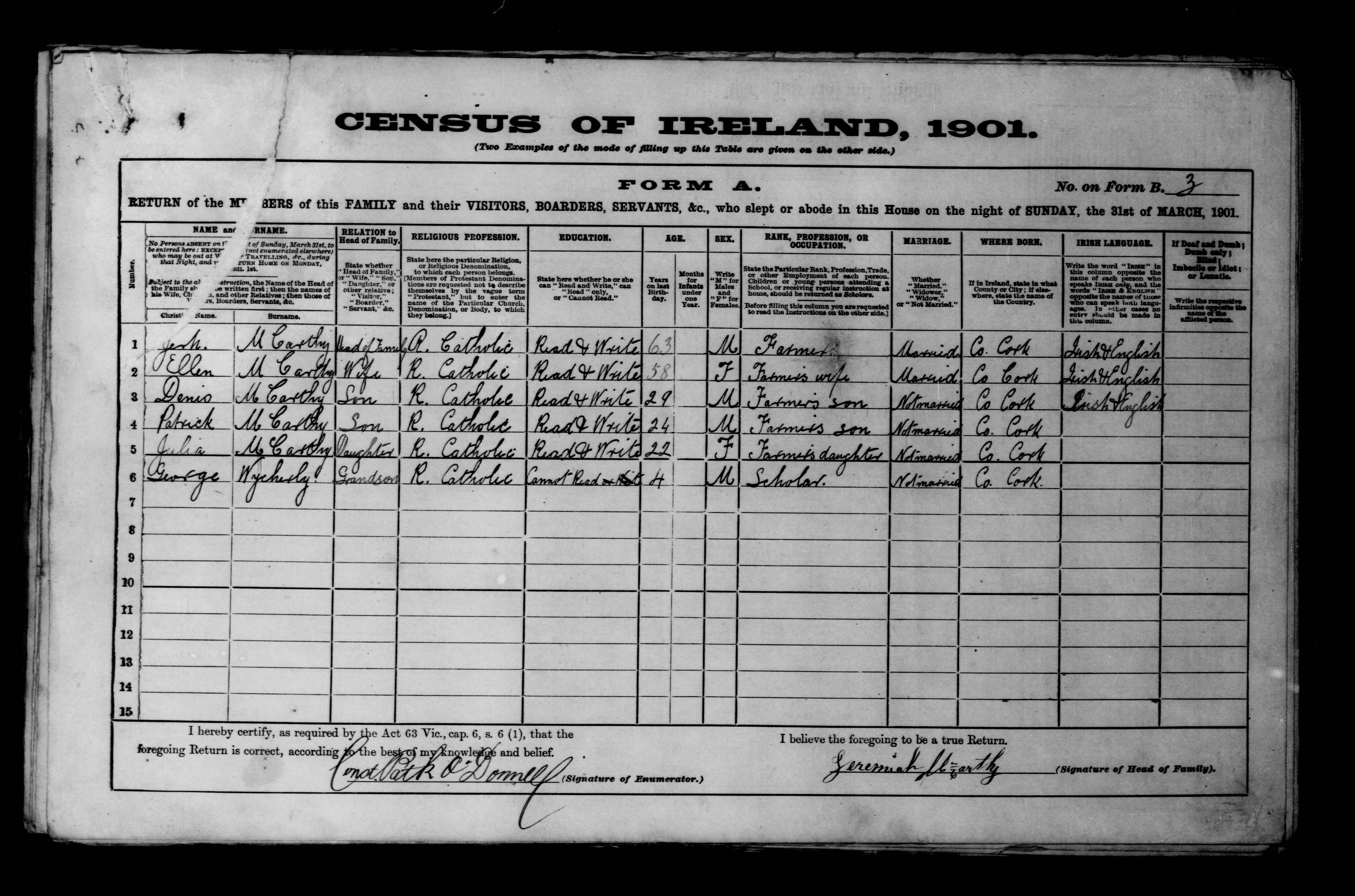
I have since gone back and found the 1911 census for Garralacka which is here:
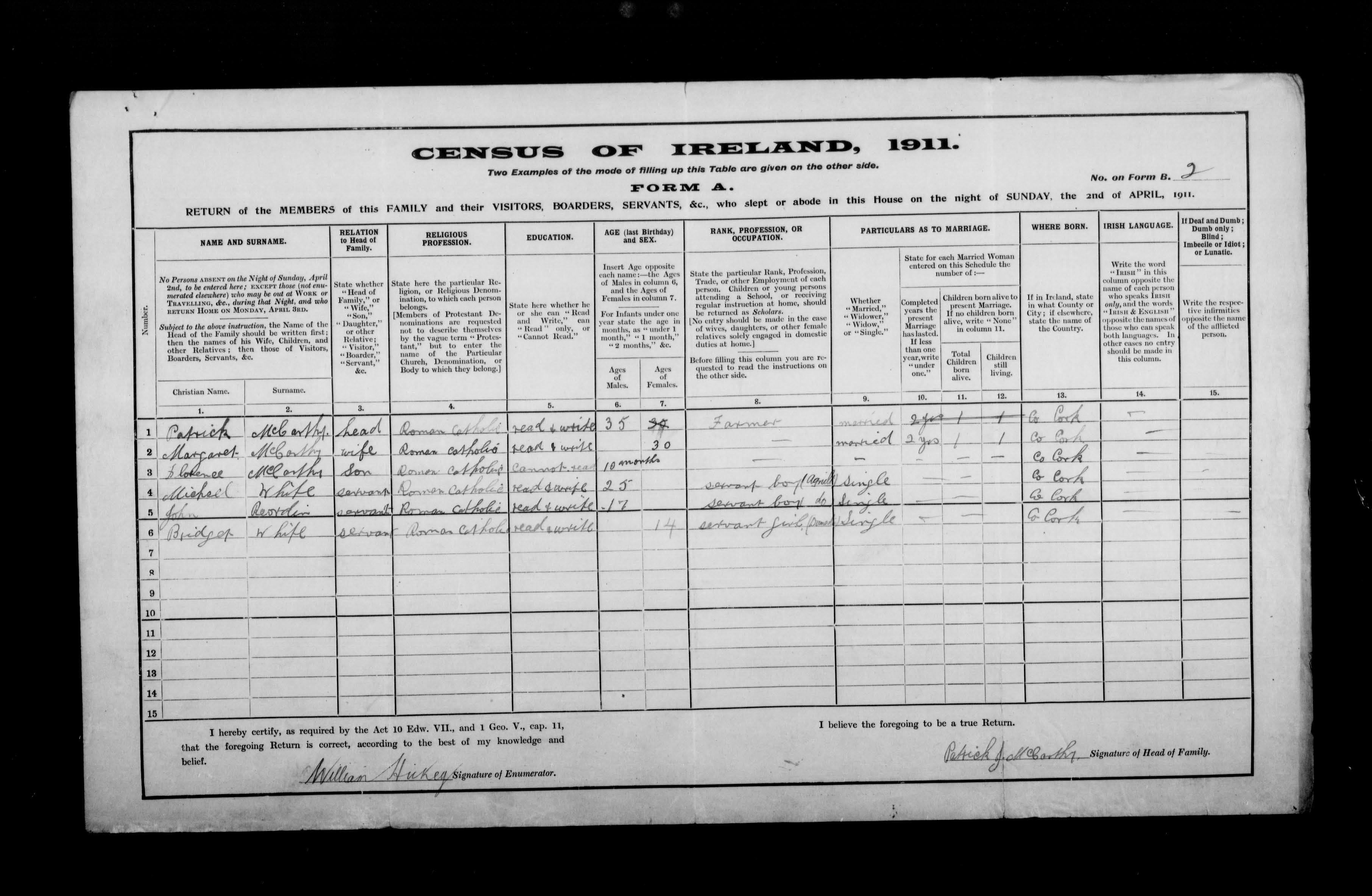
My paternal grandfather, and namesake, Florence McCarthy was 10 months old at the time, and appears at entry no. 3; his father, Patrick, was head of the household and is listed at number 1.
You will note from the second last column to the right, numbered 14, and headed “Irish Language” that there is a line marked through that column for each of them, and in fact for the whole household. This signifies that none of them spoke Irish.
I’ve also since gone back and found the 1901 census for Garralacka, which is here:
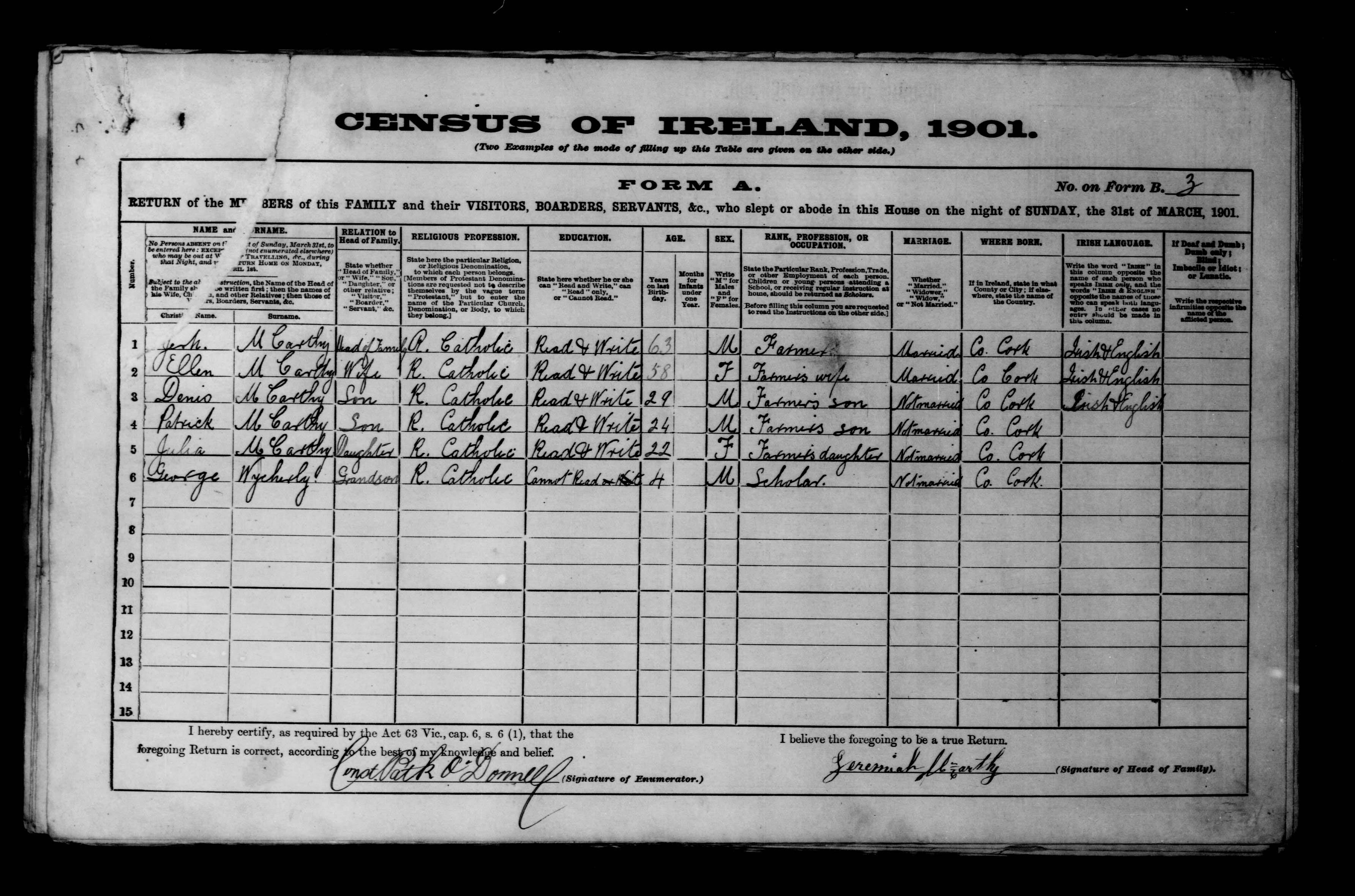
This predates my grandfather’s birth and my great-grandfather, Patrick, was 24 at that time. You will note that the same second last column from the right, headed “Irish Language” was left blank for him.
But you will also note that his older brother Denis, and his parents Jeremiah and Ellen, all have “Irish & English” written beside their names.
They were bilingual, and they were the last to be so naturally in a community language context in my family (I do have a first cousin once removed who is in my father’s generation and who is bilingual, but this is something he has pursued personally rather than it just arising naturally from the use of Irish as a community language).
These two dry bureaucratic records are very moving for me, and it feels like I can see in these images of the census forms the very moment where language shift happened within my family.
The point at which it was decided that if English was to be the language of progress and opportunity then we had better adopt it, and encourage our children to speak it to the exclusion of that other language that would be no good for them as they try to make their way in an English-speaking empire upon which the sun was supposed to never set.
It was a point where one generation sacrificed themselves and chose to suppress their native tongue, they thought of as the past, so that the next generation might have a better chance with the language they thought of as the future.
And it makes me think, of the relief and joy that I felt as a young boy upon hearing my grandfather’s voice in the place where he too had grown up - which signified for me deliverance from the boredom of that work in the glasshouses - that when he was my age then, the kind, gentle, and fascinating voice that he would have heard, and that would have been so welcome to him, from two generations before him, would have been speaking to him in Irish.
P.S. This is Day 2 in a 21-Day series on The Irish Language and Its Role in Irish Identity you can start at Day 1 here or you can read Day 3 next here.