
Inis Meáin
Sense of place - place of sense

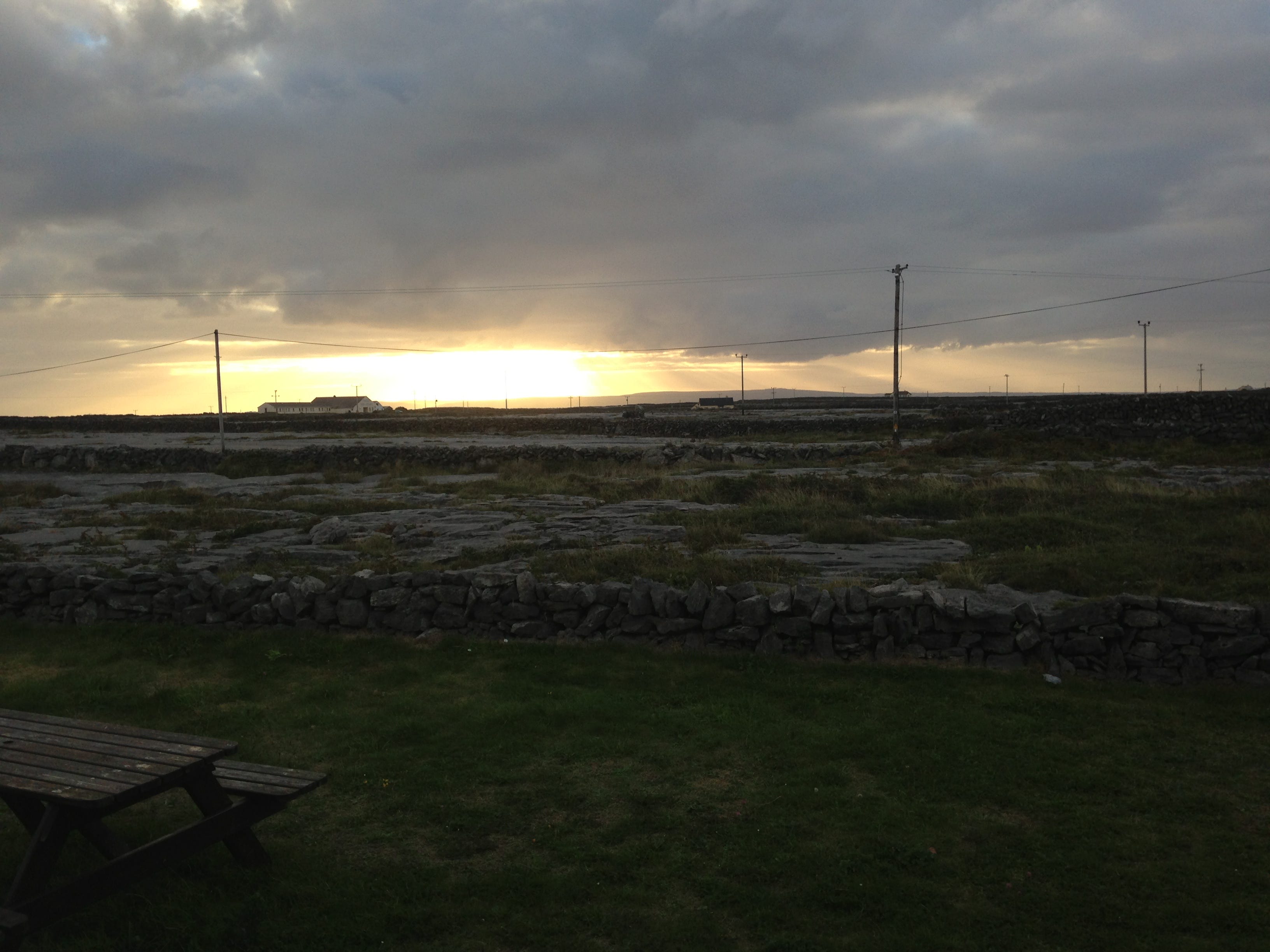
The first thing that strikes you about Inis Meáin is the quietness, the peace; it is serene.
We first went there 15 years ago now, when the children were very small. We were in the depths of the aftermath of the 2008 financial crash, which had hit Ireland disproportionately hard, and things were really miserable on the economic front, domestically and nationally. Foreign holidays were off the agenda, and some friends had suggested Inis Meáin as they had a family connection there.
I wasn’t into the idea, I have to confess. It was before I had reconciled myself with the language and, in an Ireland where the mood and the weather had transcended pathetic fallacy and melded into a constant mist of misery, the idea of a staycation to a Gaeltacht area as an alternative to the prospect of some warm sunshine really did not get me going.
We arrived on the first evening and had had no idea what to expect; the remoteness felt profound. After the ferry drops everyone off at the pier on Inis Meáin, and the boat leaves, and then all who have disembarked leave, and there is nothing there.
Literally nothing.
Seachas cúpla gobadán b’fhéidir ~ apart perhaps from the odd sandpiper…
We got a lift to the house where we were staying, and it was extraordinary; this little house in a stone field.
Not a house in a field with stones in it, but a house in a field of stone. The surface of the field was comprised entirely of solid stone; karst limestone in fact, as Inis Meáin and the Aran Islands as a whole are part of the rock formation that makes up the Burren. They are politically in Galway but geologically in Clare.
It is the most extraordinarily beautiful place.
The first thing that happened when we landed was the kids asked if they could go explore. They were very small at the time; we have five, the youngest was then 2 up to the oldest 9.
It was a lovely evening and we figured why not. The immediate sense you have on Inis Meáin is the sense of security and safety of the place. With small kids in our lives at home we were continually anxious about everything: are they going to run out into the traffic; will they fall off some precipice; is there stranger danger?
On Inis Meáin, all of this seemed to fall away, there are very few vehicles, and any that pass the roads do so at a pace that respects the nature of the place, and can be heard coming from far off; and the pedestrian footfall is extremely light to non-existent.
So off they went, and this magical time seemed to stretch out into golden hours, when we were just there, present in time, enjoying the evening, unpacking, settling; just being. But then it felt like a considerable amount of time had passed, and we thought, hang on, it’s all too quiet, where are the kids?
We went outside to look, and there they were, just there; visible a little way off on the flat moonscape that is the lower northern part of Inis Meáin. You can see all that there is, around you on that part of the island, while standing on any part of it; as it is all so flat, intersected by continual low stone walls.
They eventually got hungry and came back, and there started what has been to date 15 blissful years returning each year to a magical place of tranquillity and one that I wouldn’t have chosen to go to, if it had really been down to me in the first place.
A couple of years later, we were back again, and everyone was a little hardier. One day, we were going up to Dún Chonchúir, the larger of the two massive stone ring forts that are on Inis Meáin. It is in the middle of the island where the ground is considerably higher than the northern end.
The route to the Dún requires you to go over a patchwork of little fields, some no more in size than chambers carved out by the ubiquitous stone walls, with a roughly marked path and stiles along the way. The ground rises up here to the Dún and the walls seem higher relative to the undulating ground in places, to the extent that as each person goes through each little field as they go towards the Dún they disappear and reappear as they go over each wall and through each field.
Our daughter, the youngest, had gone ahead with a couple of the others and we were a bit behind. We could see them, but they would dip in and out of view as they made their through fields and over walls in front of us.
I noticed as they were scaling one wall ahead that there was a large uneven stone sitting loosely on the top and I called out to them to be careful. But they were too focused and determined in their task to notice or pay any attention. While the distance between us was not great, the ability to cross it was extremely limited, as you had to go up and down the walls to make progress.
Our youngest daughter went over first, climbed over the wall and the loose stone on top, disturbing it. She then disappeared out of sight on the far side, while the others followed immediately behind. The stone was now rocking and as the others went to go over it fell off in front of them, directly down on our daughter gone just before.
This all unfolded as if in slow motion before us, as if within touching distance, but across a maze of walls in between, and there was nothing we could do but watch.
The stone was large, big enough to do real to harm to anyone under it, dropping from the top of the wall to the bottom.
The older children suddenly realised the seriousness of the situation and how this big stone had fallen off in front of them as they tried to climb over it and they shouted and stopped.
Another, less peaceful, passage of time ensued in which we were just present, watching and waiting to see what would happen, what had happened in the eternity that ensued as the stone fell to earth.
And then she emerged out in front of us in the sunshine, our daughter unscathed and amused by this ridiculously huge rock that had come crashing down beside her on her adventure to the Dún.
The relief was as profound as the peace and security we generally felt in the place, that sense of how easily it could all have been so tragically different, but it wasn’t, and all was good.
But reflecting on it after, I contrasted that day at the Dún with that first evening when we arrived on Inis Meáin and allowed the kids to roam free for hours, thinking they, and we, were free from all the imagined worries we would have sought to cosset them from at home.
The outcome of each situation was the same, but here in an instant I had witnessed how all that could have changed, and how powerless I was to do anything about it.
And while we had thought this idyllic place free of so many of the threats of harm we constantly felt exposed to in modern life at home, here the potential harm had come from a simple single stone, and Inis Meáin was practically made of nothing else.
The difference, though, it struck me, was that at home we worried constantly about threats and risks of harm, economic, financial, physical; most of which never materialised.
Here we were not free from risk or source of fear, but instead freed not to worry about it unless the situation actually warranted it.
Whether this was a factor of the place, pace, or way of life, it didn’t matter; the freedom was enough ~ ba leor an tsaoirse.
P.S. This is Day 3 in a 21-Day series on The Irish Language and Its Role in Irish Identity; you can start at Day 1 here or you can read Day 4 next here.