
Gazetteer
Leabhar Iontas ~ Book of Wonders

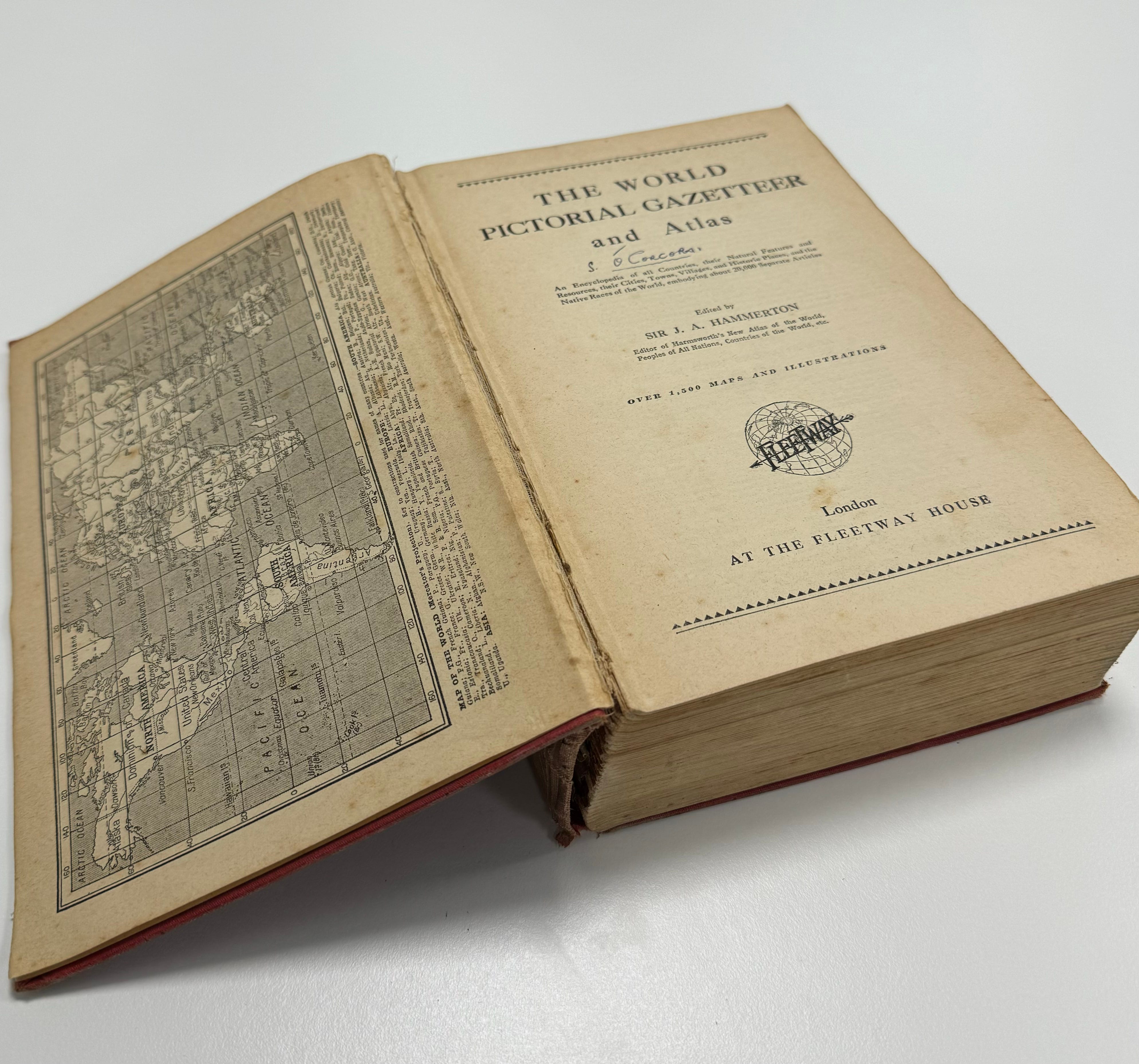
Tea and Marietta biscuits, those are the tastes of my maternal grandparents’ sitting room. My Grandad Corkery had been principal of a boy’s national school in Cork city and my Granny Corkery has been principal of a nearby girl’s national school, they had retired to a little bungalow in the countryside on the outskirts of the north side of the city, where Grandad gardened and Granny made delicious jams and jellies.
Every day in late morning elevenses would be had in the sitting room consisting of tea and Marietta biscuits.
Grandad Corkery was from the town of Macroom and his family and his family had moved it there from the breac Gaeltacht that is the Muskery Gaeltacht that spreads out west of Macroom. Breac Gaeltacht, literally means speckled, or mixed, Gaeltacht as there has historically been a mixture of English and Irish speaking households in the area for a long time. (Incidentally Hugo Hamilton has written an excellent memoir on the complex relationship that is growing up with with Irish, English, and, in his case, German in The Speckled People.)
Here is the 1911 Census for the Corkery family in South Square in Macroom:
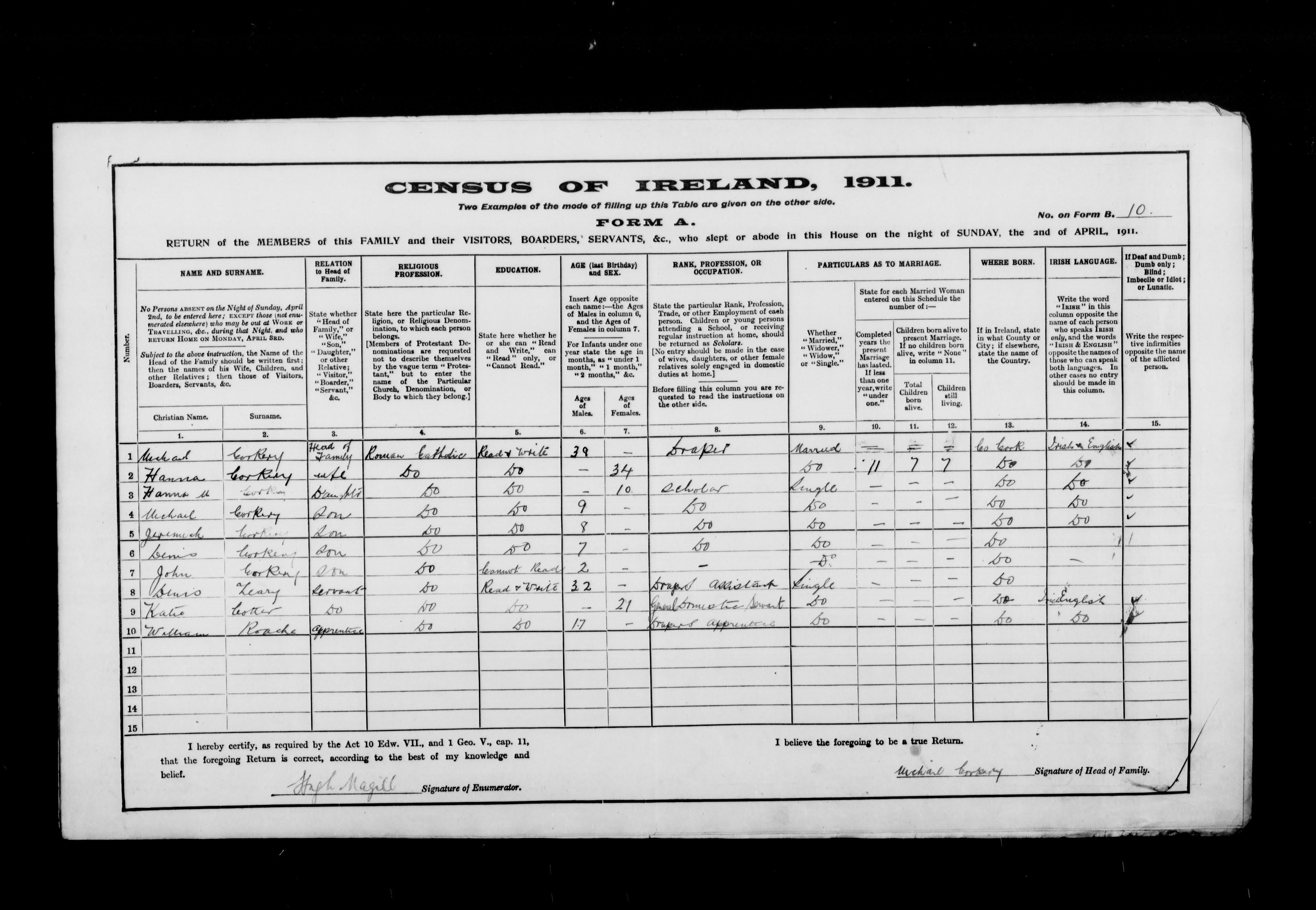
Michael and Hanna, my great grandparents, listed at rows 1 and 2, and the first three children, Hanna, Michael, and Jeremiah, then aged 10, 9, and listed at rows 3 to 5, are all described as speaking both Irish & English in column 14 under the heading Irish Language. The entry for the fourth child, Denis, then aged 7, listed at row 6 is left blank in column 14, and it is not clear if this is to signify that he spoke English only, or is just an omission.
(You may recall that in the case of my father’s family there seemed a clear break in the 1901 census where the parents and eldest son spoke Irish and English but the younger siblings spoke English only. However, in that case my English only speaking great grandfather Patrick was 24 in 1901, whereas Denis here is only 7 in 1911, and the other 3 young children, aged 8 to 10, all spoke Irish and English, so this does not seem to me to be likely to be a clear, deliberate linguistic break in the family.)
Grandad Corkery, John, then aged 2, is listed at row 7, and there is a line through the entry beside his name in column 14, presumably because he was just too young at the time.
Michael Corkery, the head of the household, was a draper. And you will note that as well as the family members there were three staff members in the house on the night of the census: a draper’s assistant, named Denis Leary, aged 31, who is listed as speaking English only; a general domestic servant, named Kater Cotter, aged 21, who spoke Irish and English; and a draper’s apprentice, named William Roach, aged 17 who spoke Irish and English.
So, I think it is safe to say that Grandad Corkery would have grown up in a bilingual household.
Granny Corkery was from Sligo, and the census records show the household in which she grew up as speaking English exclusively in both 1901 and 1911. But she and Grandad Corkery were both primary school teachers, indeed, both became principals, and spoke Irish fluently. The language of their own household was English. (However, their eldest son, my uncle Mícheál is fluent in the language, has always been deeply passionate about it, and, I believe, actually read the news in Irish for a period in the relatively early days of RTÉ.)
Grandad Corkery would have his tea and Marietta sitting in a wingback armchair by the window, doing the crossword in the Examiner (now the Irish Examiner, then, and really, the Cork Examiner). To the left of the armchair, on the wall beside the window, was a bookcase. It was an old piece of polished fine furniture, with little goldie decorative inlays along the edges.
The mid-section was a kind of bureau with a cover that would fold out to form a kind of desktop, though no one ever sat at it as a desk. It was hinged with a satisfying metal sort of lever mechanism, with a little key that fit into the neat brass keyhole at the top on front. It was fun to open and close for a while.
Above the bureau were a couple of bookshelves, and on these Grandad Corkery kept the mysterious books with the runic script I mentioned on Day 1, which I now know were written in Irish in the cló Gaelach, or Gaelic type. These were interesting as artefacts up to a point, but after exhausting a physical inspection of them, they were just placed back on the shelf as curiosities that were of no interest or use to me. (As I never paid any attention to these books, I never cared to find out what had happened to them when it mattered after Grandad died, and now no one knows; something I regret immensely.)
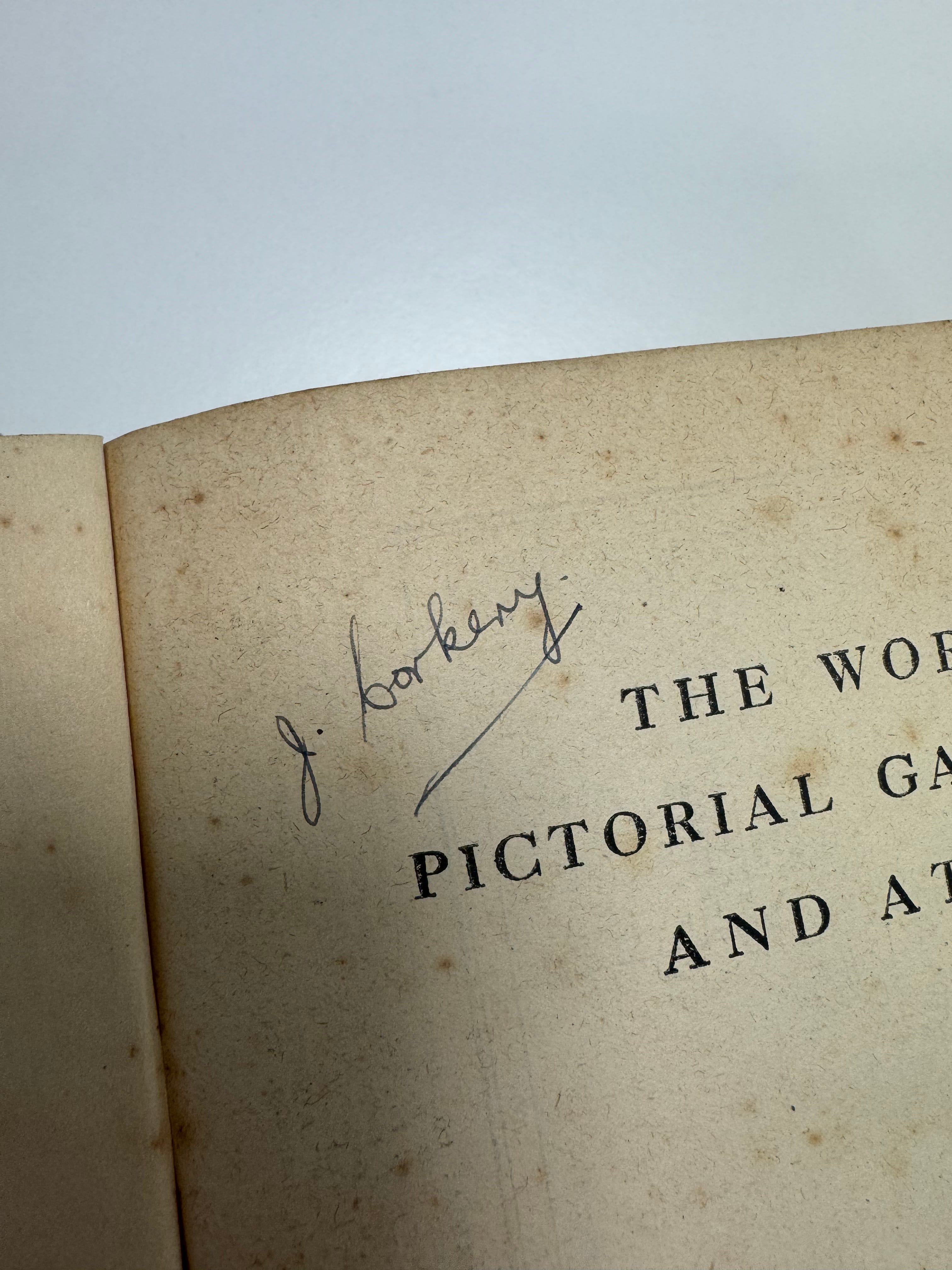
There was one book on those shelves that did hold my fascination, the World Pictorial Gazetteer and Atlas. He had put his name on the outside cover as J. Corkery, his name in English was Jack Corkery.
But he had put his name inside as S. Ó Corcora, Seán Ó Corcora, his name in Irish.
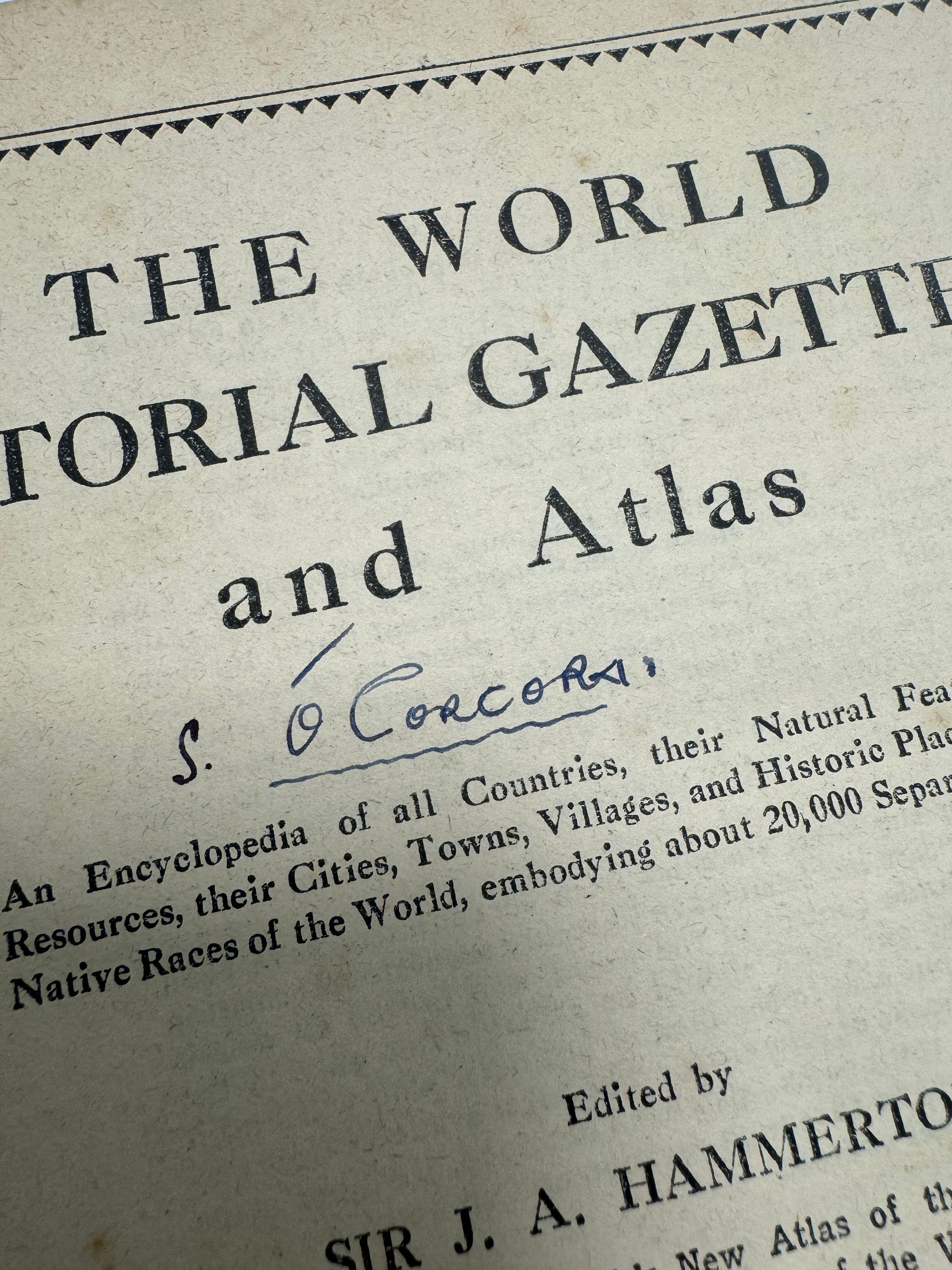
The book was from the 1930’s but entirely Victorian in nature: the world captured and described from the perspective of the British Empire, as a kid I would read it in bed between the old fashioned linen sheets and blankets in my Granny and Grandad Corkery’s spare bedroom each night as I fell asleep, imagining the strange places described in the heavy book which would fall to the floor in a heap when I dropped off, to be gathered up by my Grandad when he would do his rounds before going to bed himself.
As part of the MA course in Modern Irish in UCC there is an excellent module on An Scríbhneoireacht Chruthaitheach ~ Creative Writing; the course includes poetry writing, something that I had never really considered as a medium previously. When given an exercise, I surprised myself to find that the Gazetteer was what came to out:
Gazetteer
Thitinn i mo chodladh leis an nGazetteer
i gcúl seomra leapan mo sheantuismitheoirí.
Leabhar iontas na himpireachta Victeoiriach,
a bhí ag mo Dhaideo ó na tríochaidí,
agus cúis iontais nua domsa sna ochtóidí.
Sínithe J Corkery ar an clúdach;
agus S. Ó Corcora thaobh istigh.
Áit ina fuaireas Clanna Chaoilte agus Cloncurry taobh le chéile:
CLONAKILTY. Urban district, market town
and seaport, Co. Cork, I.F.S …
Here are corn and flax mills,
And close by are Druidical remains similar to those at Stonehenge.
Market day, Fri.
Pop. (1926), 2770
CLONCURRY. Town of Queensland, Australia.
It is a railway junction and road centre,
Here the railway branches N. to Coolulla and S. to Dajarra.
Copper has been mined here since 1887 …
Pop. 1,100
Baile mór in Iarthar Chorcaí ní aithním:
Cá bhfuil an calafort agus muilte an línéadaigh?
Agus iarsmaí na ndraoithe?
An bhfuil acomhail iarnróid agus mianaigh copair
fós i dTír na Banríona?
An vardrús lán le prócaí suibhe
cuiríní dubha agus glóthach úll
mo Mhamó.
Agus mé faoina braillíní línéadaigh
seachas gnáthdhuivé baile.
Titeann The World Pictorial Gazetteer
ar an urlár ina chnap.
Here’s a precis of the meaning of the Irish words, in case that is of any interest and assistance:
Gazetteer
I used to fall asleep with the Gazetteer,
In my grandparents’ back bedroom.
A book of wonders of the Victorian Empire,
of my grandfather’s from the thirties,
and a source of wonder for me in the eighties.
Signed J. Corkery on the cover,
And S. Ó Corcora inside.
A place where I found Clonakilty and Cloncurry side by side:
CLONAKILTY. Urban district, market town
and seaport, Co. Cork, I.F.S …
Here are corn and flax mills,
And close by are Druidical remains similar to those at Stonehenge.
Market day, Fri.
Pop. (1926), 2770
CLONCURRY. Town of Queensland, Australia.
It is a railway junction and road centre,
Here the railway branches N. to Coolulla and S. to Dajarra.
Copper has been mined here since 1887 …
Pop. 1,100
A town in West Cork I did not recognise:
Where was the seaport and the flax mills?
And the Druidical remains?
Are there railway junctions and copper mines
still in Queensland?
The wardrobe full of pots of
my Granny’s
blackcurrant jam and apple jelly.
And I under linen sheets
instead of the usual duvet of home.
The World Pictorial Gazetteer falls,
in a heap on the floor.
P.S. This is Day 4 in a 21-Day series on The Irish Language and Its Role in Irish Identity; you can start at Day 1 here or you can read Day 5 next here.