
Saipan
You have to a choose a side

Over the Christmas break I went to see Saipan with my youngest son. In case you are unaware, Saipan is a fictional film based on events that took place when the Irish soccer team qualified for the World Cup in Japan in 2002. The Football Association of Ireland (FAI) arranged a shambolic pre-tournament preparation camp on a Pacific island called Saipan.
Mick McCarthy was the manager of the Irish team and Roy Keane its best player; there was a famous bust-up and Keane went home before the tournament even started. The side you took on the Mick/Roy controversy in 2002 was as consequential for your relationships with others in Irish life as say, which side you took on the question of the Anglo-Irish Treaty in 1922; and has the potential to be as long-lasting in terms of grudges held.
I’m not really into sport, I think it must skip a generation in our family as my father is completely sports mad (as a spectator rather than a participant), as are two of my sons. However, my Grandad McCarthy was completely indifferent to any kind of sporting activity, which I like to think formed part of the great affinity we had for one another.
My son is 19, and like his paternal grandad, is a big Man U fan. I have to confess that, while I remembered Saipan, I hadn’t been that invested in the whole thing at the time; though some good friends and contemporaries of mine, who I like and respect greatly, tell me that they actually had major falling outs with others at the time a result of what happened in Saipan, some with people they haven’t spoken to since…
(Spoiler alert here: to talk about this, I’m going to have to go into some of the details of what happened at the time and what is depicted in the film; you proceed at your own peril!)
It was only when watching the film that I realised that I had completely forgotten that, even after the tumultuous events of Saipan, the Irish squad in 2002 went on to get out of the group stages in the World Cup in Japan in 2002 and made it to the last sixteen, where they narrowly lost to Spain on penalties to make it to the quarter finals. And one friend of mine, who did and does know what he is talking about on matters of football, assures me: we was robbed. This is what makes the whole story such a dramatic one; imagine what might have happened if Keane had been playing…
I was discussing this with my son immediately after the film and he was deeply envious of those who had lived through a period when the quality of those available for selection for the Irish international soccer team was such as it had been in the 1990’s and 2000’s, never mind how things panned out in 2002; to him it was a golden age. (And I must confess, though not really into sport, I was 17, about to turn 18 in the summer of 1990 and Italia 90 fever was unavoidable. I left my last exam of the Leaving Certificate matric – then a thing – in Clonakilty Community College early, to watch the second half of Ireland v Romania and the famous penalty shoot-out culminating in Packie Bonar’s save, and Dave O’Leary’s winning goal - olé - in Pa Houlihan’s pub, the Blackbird; a rare golden hour or so of sport for me that I shall never forget.)
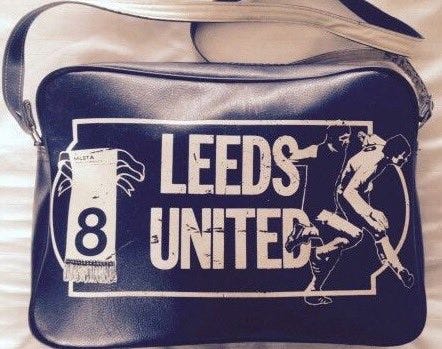
The funny thing about soccer in this part of the world is that it is quintessentially English, every serious soccer fan in Ireland identifies with an English club (we’ll leave Glasgow Celtic out of it for now.) When I was going to school in the 70’s everyone had these kind of small rectangular kit bags they would use as school bags; they would have the insignia of their chosen club: Liverpool; Manchester United (Red Devils – that logo stands out in my mind); Arsenal (the Gunners, another memorable image of a cannon on those particular bags).
As I had no interest in soccer, I had a very boring leather school bag. One day, ehen asked the question of who I followed at school, I was utterly, and very publicly, embarrassed when I had no answer. I decided to do something about this, and as soon as I could get my hands on some money, I marched down to Paddy Meade’s, the local newsagent on the main street in Clonakilty at the time, where, along with sports magazines and the like, they sold the odd bit of sporting paraphernalia. There was no question of getting anything as sophisticated as a team kit bag in Clonakilty, that would have required, at very least, a trip to Cork city. But Paddy Meade did have team watch straps. There was only one left: a Leeds United strap; so I bought that, deciding it was better than nothing, and at least I could hold it up in future when interrogated on where my allegiances lay.
Had I gotten into soccer, and stayed true to my choice, I guess I would have remained a lifelong Leeds United fan as a result, but thankfully, the fad passed, I lost the strap, and, though I wish Leeds the best, I have no idea how they have fared since.
And while there are Irish soccer clubs, and an Irish league etc., the English premiership is where it’s at when it comes to soccer for serious aficionados, the beautiful game and all that. Even the most fervent of Irish political and cultural patriots, who is in any way into soccer, will follow an English soccer club that they probably ended up following purely by chance as a child; though they probably did have a little better reason than their club being the last watch strap available over the counter in Paddy Meade’s in 1979.
Similarly, most of those who qualify to play for the Irish national soccer team play for English clubs - ones in the Premiership if we’re lucky - and they often qualify to play for Ireland because a parent or grandparent was born here. Many are born and live all of their lives in England.
And this brings me to the dénouement of Saipan - now it is important to mention here that Saipan, the movie, is a work of fiction; and many of those there at the time have said that some of what is depicted in the film did not happen, or did not happen as depicted; but let’s not let the truth get in the way of a good story here, shall we.
The basic premise is that Keane, played by Éanna Hardwick, is the serious world-class athlete; he has the best talent, has worked the hardest at it all his life since a child, and he wants nothing but world-class excellence for himself and his country as they go out to compete on the greatest stage of international football. The Ireland set-up, run by amateurish FAI apparatchiks, on the other hand, is depicted as a risible shambles; a bunch of loveable Paddies, there for the craic, led by gombeens. Mick McCarthy, played by Steve Coogan, as manager, is representative of the whole FAI culture, and he and Keane continually clash.
An important detail here is that Roy Keane was born and reared in Mayfield in Cork city, and, while he played the majority of his soccer career with Manchester United, and lived, and still lives, in England, he is unquestionably as Irish as it gets, and north Cork city Irish at that.
Mick McCarthy was born in Barnsley in Yorkshire. His dad, Charlie was from Tallow in Co. Waterford which enabled McCarthy to qualify to play for Ireland. McCarthy speaks with a strong Yorkshire, as in, English accent. McCarthy captained the Irish soccer team the first time the team ever qualified for a World Cup in 1990, under Jack Charlton, another Englishman who has revered status in Ireland for what he did for Irish soccer during the Charlton era, of which my son was so envious. Keane was a young player at the time, and also ran in with Charlton.
This all forms the backdrop for the dynamic between Keane and McCarthy in Saipan, with Keane mocking McCarthy for having been condescended to, and, as he described it, patted on the head by the Englishman Charlton in previous Irish World Cup outings in 1990 and 1994.
The build-up all leads to a famous showdown at which, in the film, Roy really tells McCarthy what he really thinks of him and calls him a plastic Paddy, and an English c***.
The rest, as they say, is history. Keane goes home, has no further part in the Irish World Cup effort, and Ireland ultimately go out on penalties to Spain, missing what would have been an unprecedented place in the last eight in the world, robbed...
And here’s what struck me while watching and thinking about Saipan: the Keane McCarthy dynamic as depicted in the film is the perfect metaphor for many people’s emotional relationship with the Irish language as Irish people; with the Mick McCarthy character representing Irish people who don’t speak the Irish language, and the Roy Keane character representing the language itself inside the heads of the former.
Ultimately, internally, the inability to speak our own language causes us to feel that we are somehow not complete as Irish people without the ability to access this thing that is at the core of Irish culture: we stand vulnerable to being accused of being plastic Paddies, maybe not to be as extremely stated as the Keane character’s English c***, but it’s not far from that other deeply cutting thing to be called as an Irish person, a west Brit.
And while I’m no psychologist, I do have a theory that this situation gives rise to this intolerable internal cognitive dissonance within us: we are Irish, and very proud of this fact, but we don’t have this thing that is integral to Irishness, our own language, and without it, are we really plastic Paddies or west Brits, or perhaps worse?
And so, what do we do in this situation?
Well, there are two choices:
One is to resolve this cognitive dissonance by reconciling with and acquiring the language and making ourselves whole.
This is hard. Though it can be done incrementally, to whatever level we wish, and it provides a satisfying, deep resolution to the problem.
The other is to reject the language utterly in an attempt to remove it as the source of problem: dismiss it as an impossible, practically dead, language; that they tried unsuccessfully to beat into us for 14 years at school after which we couldn’t speak a word of it, which means it clearly can’t be our fault; and which now represents nothing but a monumental waste of time, effort and taxpayer’s money; that is of no practical use to anyone.
This is easy. But ultimately superficial, and does not resolve the underlying cognitive dissonance, which remains within us despite our indignation.
And a bit like Saipan, we have to choose which side we’re on.
P.S. This is Day 5 in a 21-Day series on The Irish Language and Its Role in Irish Identity; you can start at Day 1 here or you can read Day 6 next here.