
Caoineadh
Crying

Granny McCarthy died on 22 November 1984. I was twelve and had just started First Year in secondary school that September.
My father woke me in the morning to tell me the news and to let me know we wouldn’t be going to school.
After he left, I lay under the duvet, whacking myself on the side of the head, feeling terrible that I did not feel as bad as I thought I should have in the circumstances, and also guilty that I was indirectly deriving some pleasure from the fact that we didn’t have to go to school. Clearly, this death business was an emotional tightrope walk; one without a safety net, as it would transpire.
Granny had been a formidable figure in my mind all my life, while everyone in Garralacka called Grandad McCarthy The Boss, and Granny was happy for him to think he was the Boss; she was the Boss.
She was a stoical woman who commanded respect. Everyone had to take their wellies off going into Granny’s kitchen, even the Boss and my father and my uncles. She made the most amazing tomato soup with the surfeit of tomatoes that was produced in the glasshouses. She was a stickler for good manners and proper behaviour. She was very kind and loving, but expected your best and wasn’t going to let anyone away with anything less. She was a tall, dignified lady, with a stately bearing and a wry sense of humour.
She suffered a great many health problems towards the end of her life, many associated with bad circulation in her limbs; which involved many stays in hospital, and ultimately required a number of amputations, which, I understood indirectly, she found a very distressing violation of her bodily integrity.
For some reason, one particular visit to her in hospital shortly before she died stands out in my mind, where she singled me out, separately from my parents and other siblings and asked me, “how do you like this joint?” I found the word “joint” very unusual out of Granny’s mouth, like she was inviting us to become complicit in something together.
As her death came at a good age for the time, after a life well lived and at the end of a relatively short period of quite traumatic ill health, her death was not surprising or unnatural in any way.
But up to that point, I had been extraordinarily privileged to have had four living grandparents, all of whom had had active roles in my life. I found this utterly normal, this was the only life I knew after all - but I was also aware that this was relatively unusual: as from my experience with other kids my age in the 1970’s and 80’s, many had never known grandparents, who had often died before they were born, and few had all four living, relatively nearby.
So this was the first time I felt the hurt of the loss of someone I loved.
She died in the Bons Secours Hospital in Cork city, and the first part of the funeral process was a removal from the hospital mortuary. I had never been to any part of a funeral before. We say we do death well in Ireland, and I think that this is true; but this was my first rodeo…
While the process of an Irish funeral can be very therapeutic and allows grief to be held, it does involve quite a bit of a process, and it is a big, community affair, much of which can sometimes feel intrusive when you’re a kid, and this is a private deal between you and your granny; or at least that’s what I think now, that I might have thought then, looking back on it.
In the case of a woman like my grandmother, who had lived a long and fruitful life that had touched many, coming from a large and well known family, and then having married into another one, and then having had a large family herself, and having been involved in farming, and business, and a close knit local community; her funeral was always going to be a busy one.
To begin with, there was the question of the body, in the coffin, just there, silent in this characterless room. There were not going to be any private conspiratorial invitations on this visit.
And the process of removals involves a very long procession of people, most of whom would have been complete strangers to me; shuffling along, offering murmured condolences with varying levels of detail and familiarity. The worst being those who engaged in protracted, self-indulgent individual commiserations and reminiscences with some, or all, of the adult family members lined out to receive this huge, slow crowd, thus stopping the procession’s shuffle entirely, and leaving everyone else stuck behind, standing awkwardly still, with nowhere to look.
My parents would have had to assume their positions there, in the line-up, and I and my four brothers were sitting in a front-row spot, as everyone inched along, in uncomfortably close proximity before us.
And then, out of the blue, I just erupted in floods of tears. I started crying the most uncontrollable sobs I had ever cried in my life, or have cried since – and I wasn’t, and amn’t, really that much of a crier.
I was the eldest of four brothers, all of whom were seated alongside me. I was twelve and had just started secondary school, and I was supposed to be a big boy and the oldest brother.
But then, in sympathy with me, and as if by contagion, one-by-one, my brothers all broke out in tears alongside me.
I was utterly embarrassed as these strange adults passed by, step-by-step, shaking hands with Grandad McCarthy, my parents and uncles and aunts, as we sat there out in front crying, in a way that I can only describe as feeling nakedly exposed in this fundamentally private act. We weren’t the types who carried hankies or tissues, and I had nothing to mop up the tears and snot but my sleeves.
It seemed to continue forever. Vomiting tears in convulsions.
Some adults would make kind noises of sympathy on how natural it was to feel this way on the loss of your granny, but it just felt like an endless public exhibition of emotion that I had not agreed to and could not control, or end. Eventually, my Granny and Grandad Corkery arrived and were able to console us. Not being immediate family to the deceased, they were able to be with us, as opposed to having to solemnly meet and thank all the endless others who had come to express their condolences.
It was the first time I had lost anyone that I had loved; and it was the most visceral, public, emotional pain I have ever experienced.
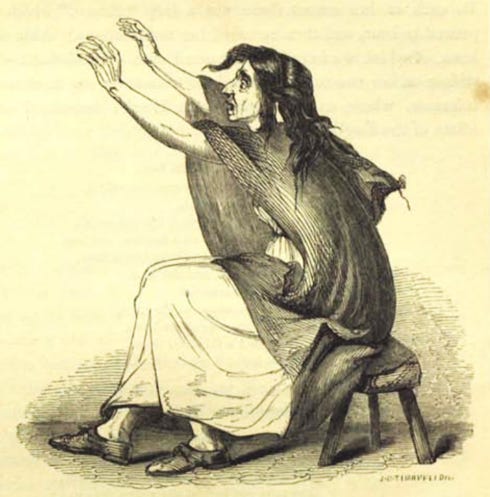
Crying is caoineadh as Gaeilge, and in this context, is referred to as the keen, or keening, in English; the lament for the dead.
It was a female oral and literary tradition, and was an essential part of Irish funeral ritual up to the middle of the Eighteenth century.
It is often said that Irish is one of the oldest written languages in Western Europe, with one of the oldest literary traditions; far older than English, for example. And poetry would have comprised the bulk of this tradition.
But it is important to understand that literature here, and literacy in general in this context, was not something that was intended for the community as a whole: reading, writing, and the related art of poetry were an elite activity, reserved primarily to the filí, the poets, and the Gaelic nobility who were their patrons.
Poets were exclusively male, and poetry was an entirely male domain. Nuala Ní Dhomhnaill has her own lament on the role of the woman poet in the Irish tradition in her Selected Essays.
The notable exception is Eibhlín Dubh Ní Conaill’s lament for her husband: Caoineadh Airt Uí Laoghaire. Ní Conaill was of noble birth; her family were the O’Connell’s of Derrynane. Daniel O’Connell was to be a nephew of hers.
The prestige of her background is almost certainly the reason why her lament was written down. Doireann Ní Ghríofa in A Ghost in the Throat quotes Peter Levi in his inaugural address as Oxford Professor of Poetry as calling it “the greatest poem written in these islands in the whole eighteenth century”.
Ní Ghríofa’s book concerns much of itself with trying to discover Eibhlín herself, as a woman and a poet, not just as a wife, and an aunt, as she is so often referenced. Ní Ghríofa also provides us with the poem, with the full text as Gaeilge, and her own English translation.
Ní Dhomhnaill credits the recording of that Irish language text of the poem to a West Cork woman, Norry Singleton, herself a keener, but of a much less nobler station in life than Ní Conaill.
Keeners were women who were generally poor, old and often living alone. Ní Dhomhnaill quotes Angela Bourke in arguing that:
Irish women lament-poets were doubly colonised; they belonged to a society and composed in a language considered inferior and barbarian to those in power, but even within their own society they were an underclass, not taught to write, not admitted to the academy of serious poets, rarely named as authors of their own compositions.
As Ní Dhomhnaill goes on to say:
There may have been hundreds, even thousands, of them, and yet with the one exception of Eibhlín Dubh, none of them have made in into the canon.
The tradition of keening had long since died out by November 1984, and I was never aware that it had ever even existed at all at the time.
But I can tell you that unbeknownst to myself, I sorely missed it, and those women poets, that day; and how I would have longed for their sonic cover over that shuffling and murmuring exposition of tears.
P.S. This is Day 6 in a 21-Day series on The Irish Language and Its Role in Irish Identity; you can start at Day 1 here or you can read Day 7 next here.