
State-sponsored Confusion
In Irish public signage

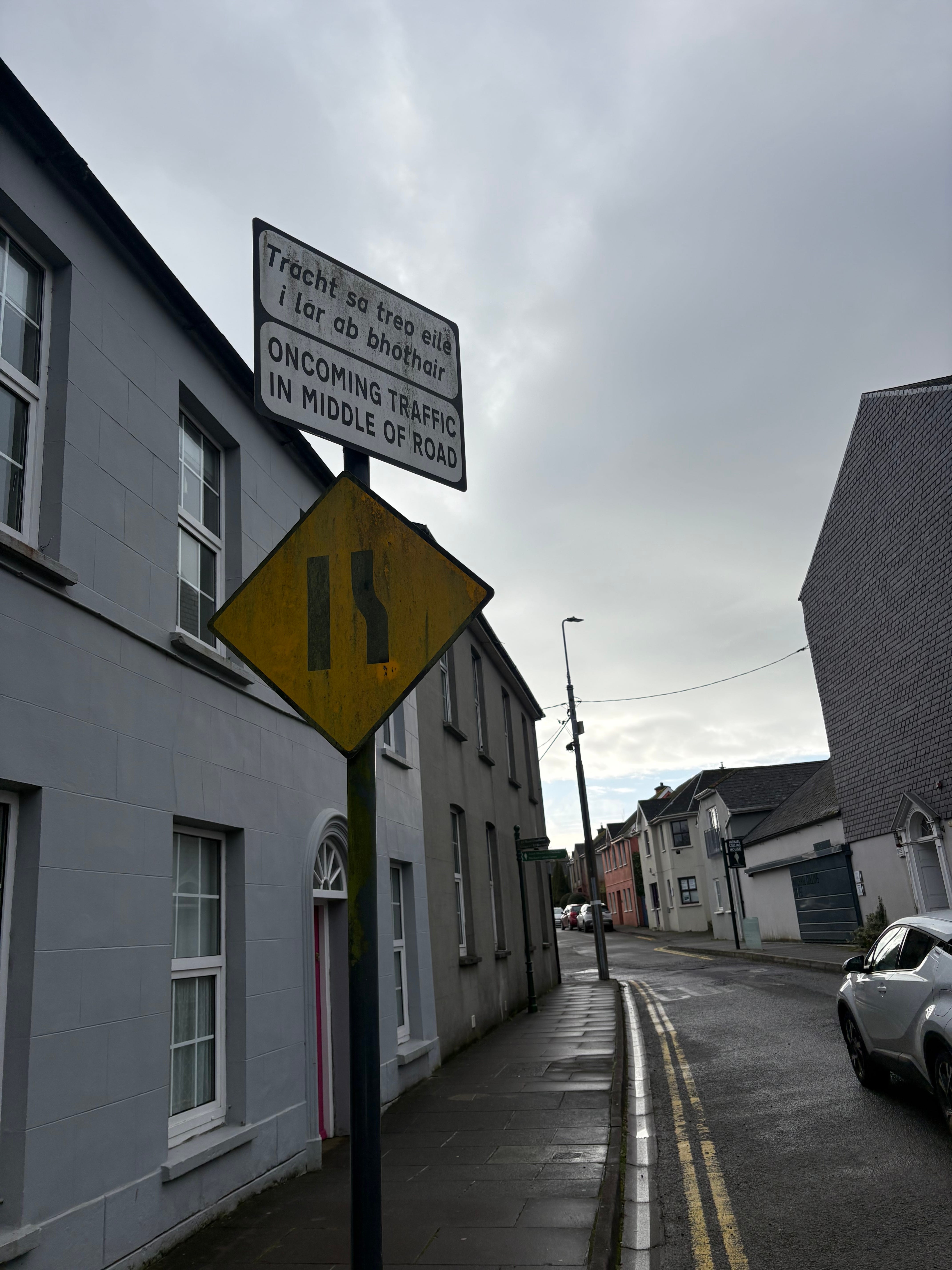
Confusion may be unavoidable when learning Irish as an adult, or any language at any age, I suppose. Making mistakes can make us feel dumb, sure, but I have long taken the view that making mistakes is a natural and inevitable part of learning, and therefore rather than wish to avoid mistakes, I tend to embrace them. I don’t go out looking to make mistakes, but I tend to think that the more mistakes I am seeing to correct, the better, that’s how we make progress.
I suppose it is trite to say that we learn from our mistakes, but then again, as someone once said, any fool can learn from their mistakes; the wise man learns from the mistakes of others.
But whatever about that, my default setting as a learner is that if I don’t understand something, I’m wrong, or have failed to get it right, and need to learn where I am going wrong in order to correct things. I’m fine with that.
What I can’t abide is being left in a state of confusion by someone who should know better, and who I believe has a responsibility to do so.
The classic case for this in Ireland is road signage. Take, for example, the photo that I have chosen as the image for this piece: it’s not a particularly nice, or good, photo. It’s a road sign in Emmet Square in Clonakilty. It has been there for years.
As an adult learner of the language, one of the ways that I like to engage with the language, in circumstances where I have precious little opportunity to do so in this English-speaking part of the country, is to observe and seek to learn from Irish whenever I encounter it.
Irish is of course the language of Ireland. And this is not just some misty-eyed aspiration, Article 8.1 of Bunreacht na hÉireann, the 1937 Constitution of the Irish State, states that:
The Irish language as the national language is the first official language.
So that road sign, in order to avoid you having to scroll up again, is here:
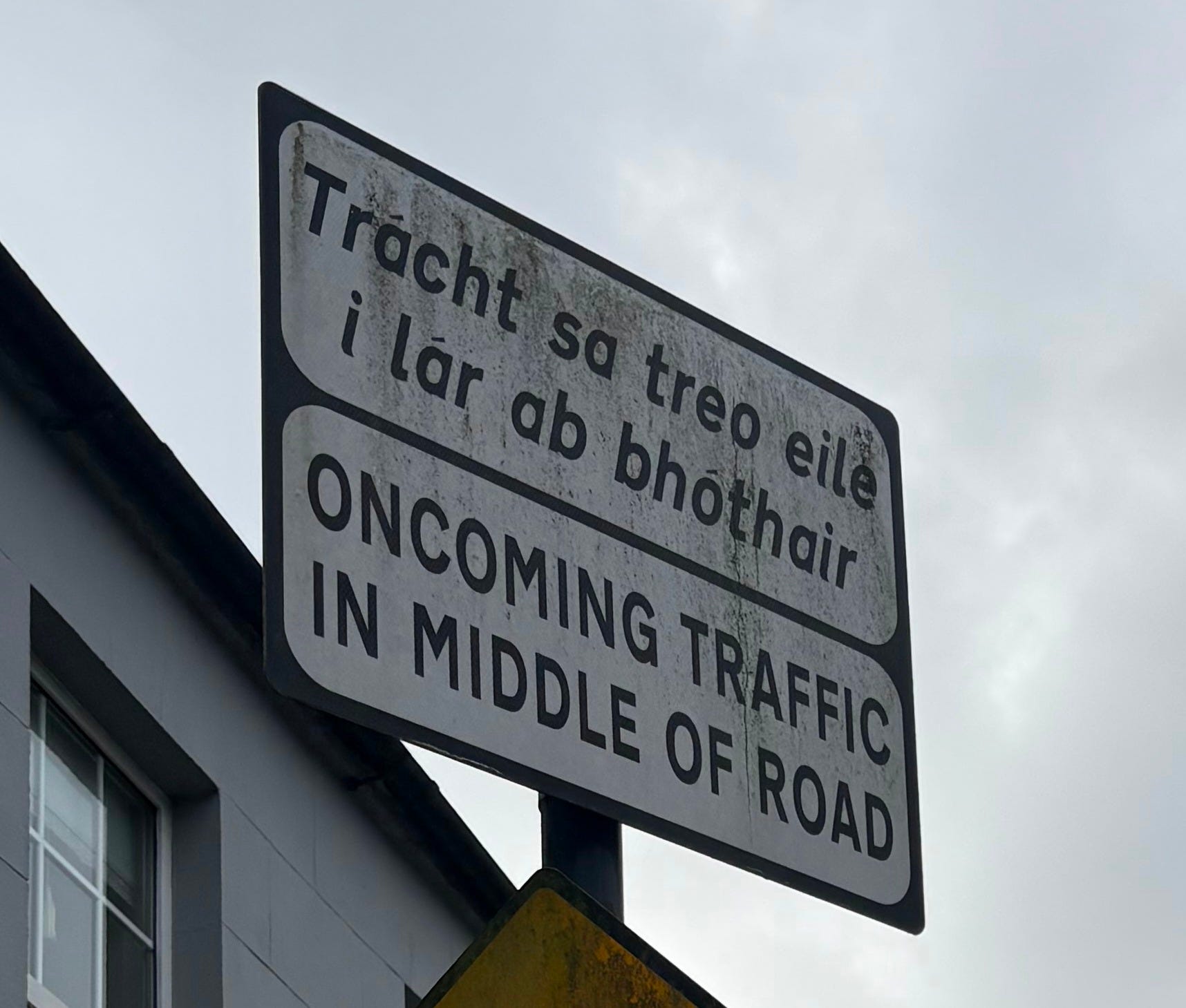
It states, at the top, before any other text on the sign:
Trácht sa treo eile i lár ab bhóthair
And it states, below those words, in black capitals:
ONCOMING TRAFFIC IN MIDDLE OF ROAD
This road sign appears at a point where the road narrows, and where there is room for only one car to pass ahead, therefore, you are likely to meet traffic coming in the opposite direction in the middle of the road immediately after you pass this sign. It’s a useful sign, some might even say an essential for the safety of road users.
Now let’s look at the words in lower case on the top of the sign:
Trácht ~ means traffic;
sa ~ means in the;
treo ~ means direction;
eile ~ means other;
i, means in;
lár ~ means middle;
ab ~ now this could be a relative form of the copula in the past tense or conditional mood used before a vowel, but that would make no sense here;
bhóthair ~ this means road, and would perhaps be familiar as bóthar in the nominative case. Here it is in the genitive case, where it is be bóthair, and as bóthar is a masculine noun, after the article in the genitive case it has a séimhiú, or h, placed after the first consonant, becoming bhóthair.
So, in essence, what I am very pedantically attempting to tell you here is that there is a typo in the sign, ab should be an and it should read:
Trácht as treo eile i lár an bhóthair,
or traffic in the other direction in the middle of the road,
or, ONCOMING TRAFFIC IN MIDDLE OF ROAD, if you will.
So, there is a typo in the sign, you say, so what?
Well, it’s gibberish, and it’s road safety gibberish. Think for a moment if such a sign would be tolerated at all for any period of time if it contained such a patent error in English. Ironically, they got the hard bit, bhóthair, right.
Such a glaring error would be noticed immediately and removed or changed as no one would want to look so stupid as to have created or allowed such a thing.
But in this case, the most likely explanation is that nobody noticed or cared when it was created, and nobody has noticed or cared sufficiently since to do anything about it.
And this is a sign erected by either the local authority, or the road safety authority, or some government or local government agency with specific responsibility for the feckin’ roads.
Now, if you’ve been around any time at all, and have any experience of how we tend to roll here in Ireland, you are not likely to be shocked to learn that someone in the Council has made a mistake and can’t be bothered to fix it.
But this is everywhere with Irish language signage in Ireland. Our local community hospital that I pass every day, has its own name (its actual name) spelt in two different ways on two separate signs that stand within a few metres of each other at the entrance. they can’t both be right people.
But who cares, or who could be bothered?
This drives me daft as an Irish citizen and learner of the Irish language. I try to learn by observing what I see around me, and I am expecting to make mistakes and learn by my self-correction of my own errors as I try to interpret what I see.
But if what I see put up by officialdom, purporting to state in the first official language what are effectively the rules of the country, as in, for example, how to drive on the road, I get confused.
And while I am a fool happy to learn from my own mistakes, I cannot forgive this state-sponsored confusion.
P.S. This is Day 7 in a 21-Day series on The Irish Language and Its Role in Irish Identity; you can start at Day 1 here or you can read Day 8 here.